14 new Kilroys have been named to carry forward the group’s advocacy for gender parity in the theatre.
By Daniella Ignacio | September 9, 2025
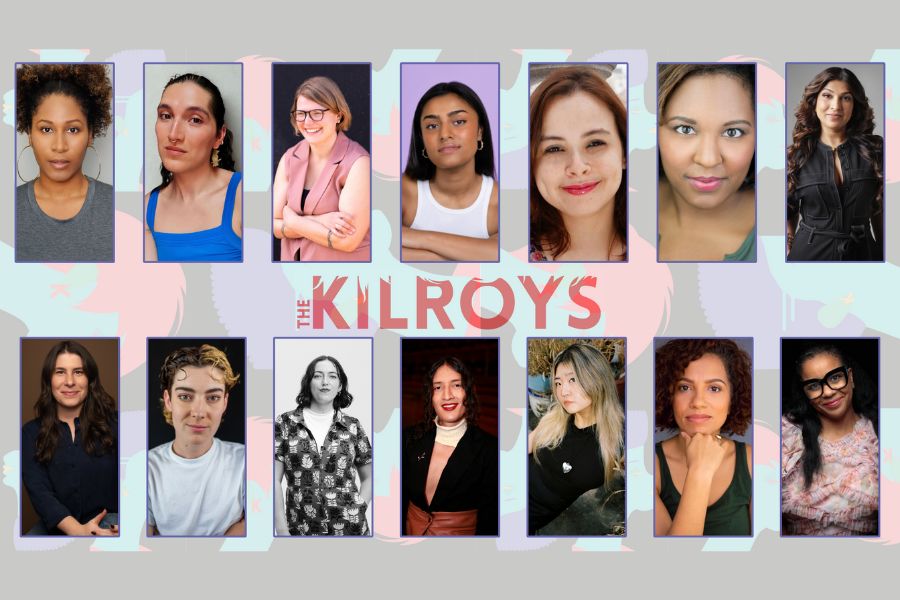
The Kilroys, a collective of artists, producers, educators, and organizers founded to advance gender parity in the theatre industry, announced 14 members of their new cohort today. Originally created in 2013 to uplift unproduced and under-produced plays by women, trans, and nonbinary artists via an annual Kilroys List, then more recently a more industry-wide resource called The Web, the Kilroys are entering a new era which, according to their statement, will “reimagine equity, power, and possibility in the American theatre.” The new cohort includes more trans and nonbinary people and members from different cities, theatrical disciplines, and generations.
The Kilroys 3.0 are Celia Mandela Rivera (she/her), Esperanza Rosales Balcárcel (she/her), Hannah Wolf (she/her), Jasmine Sharma (she/her), Karron Karr (she/her), Melissa Mickens (she/her), Minita Gandhi (she/they), Nikki DiLoreto (she/her), O’Malley Steuerman (they/he/thons), Rosie Glen-Lambert (she/her), Santiago Iacinti (they/them), Scarlett Kim (she/her), T. Tara Turk-Haynes (she/her), and Tanya Everett (she/her). Some 2.0 members, in place since 2018, will serve as advisors during the transition.
The Kilroys operate through a shared stewardship model, with a rotating structure designed to resist hierarchy, allow for replenishment, and make space for new questions, strategies, and voices. The Kilroys 3.0 team joins an organization with a legacy of reinvention. Accordingly, members say they are in a transitional phase, planning projects that include collaboration between outgoing and incoming cohorts.
From the List to the Web and Beyond
The Kilroys were founded in 2013 by Zakiyyah Alexander, Bekah Brunstetter, Sheila Callaghan, Carla Ching, Annah Feinberg, Sarah Gubbins, Laura Jacqmin, Joy Meads, Kelly Miller, Meg Miroshnik, Daria Polatin, Tanya Saracho, and Marisa Wegrzyn. They received national attention for disrupting industry norms in 2014 when they launched The List, highlighting the most recommended unproduced plays by women, trans, and nonbinary playwrights. It became a powerful tool for the theatre industry and shifted conversations on gender parity.
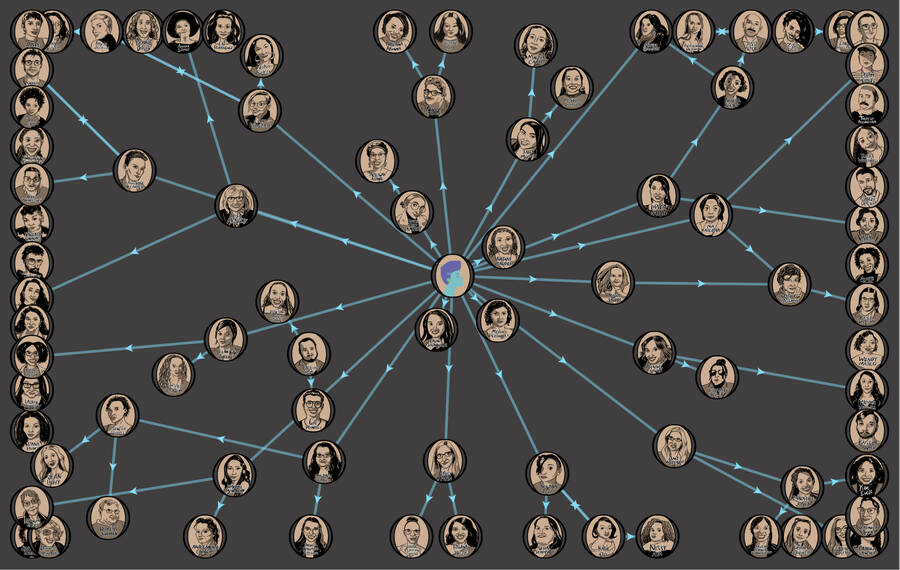
The Kilroys 2.0, who took up the mantle in 2018, are Jaclyn Backhaus, Hilary Bettis, Jennifer Chambers, Claudia de Vasco, Emma Goidel, Christina Ham, Jessica Hanna, Monet Hurst-Mendoza, Hansol Jung, Chelsea Marcantel, Caroline V. McGraw, Bianca Sams, and Gina Young. That cohort was responsible for the 2023 reimagining of The List as The Web, designed to celebrate the entire ecosystem of people advocating for new work across multiple disciplines.
In the years since the Covid-19 pandemic, the Kilroys 2.0 had “listening years” of sending out quesionnaires to people who’d been on the list, educational surveys to teachers who’ve used their books, meetings with artistic directors via Zoom, and salons to raise questions like, according to 2.0 member Chelsea Marcantel: “What do you need from us as an organization? How can we help? How can we facilitate discussion? How do we get plays produced in this ecosystem, which is so fractured?”
Marcantel summed up the gist of the responses as saying, “A list is amazing. We want to continue to signal-boost those plays that need more shine, need more attention. But these plays exist in an ecosystem. We need to do more signal-boosting of people and theatres across the ecosystem that are doing new-play development. So the mission is the same, but the mission also continues to evolve. I’m very excited to see where 3.0 takes it.”
So while the collective’s next steps are up to the new members, a statement articulated two things that “are certain: 1) The work is never done; and 2) The Kilroys do what they want.” Indeed, that last sentence has become a Kilroys mantra ever since they worried about getting their 2018 list out in time for 2018. According to Marcantel, an original Kilroy imparted this wisdom: “No one is paying us for this. We’re volunteer activists. We do what we want.” Concluded Marcantel: “We internalized that.”
In interviews, members of the Kilroys 3.0 shared collective excitement to shape what’s next. Scarlett Kim echoed the value of uplifting the ecosystem and noted the diversity of theatremakers in the Kilroys 3.0.
“As a nimble entity, Kilroys will shapeshift, as it always has, to radically champion artists in our shifting cultural landscape,” Kim said. “Our world has evolved, and in not necessarily great ways…An expansive approach feels vital to a constantly shifting and uncertain world that we live in, especially as we champion artists. The Kilroys were never about giving out awards to individuals. It was always about championing the ecosystem and celebrating all that it takes to steward this ecosystem together. We’re really excited about that being a part of that collective impact moving forward.”
For her part, Jasmine Sharma said she’s excited to participate alongside many artists she’s long admired, adding that “3.0’s commitment to parity and progress will celebrate those whose work we are still waiting to know. To be at the beginning of possibility—in this company—feels boundless.”
Over the past year, the 2.0 cohort led a national search for the next generation, each nominating and interviewing candidates across the field. The result is a 3.0 cohort that the statement calls “cheeky badasses…passionate about making our industry more daring, holistic, and equitable.”
“In a time when our country is shying away from its core values of liberty, justice, and equality, this cohort was carefully chosen for their strong vision, out-of-the-box thinking, and integrity,” said Kilroys 2.0 member Monet Hurst-Mendoza. “With their voices leading the charge, the American theatre is primed for a desperately needed shake-up that will benefit everyone.”
Indeed, this comes as conversations on gender parity, or the lack thereof, in the American theatre reignited this summer, with a scarcity of women’s representation in Off-Broadway and regional theatre seasons such as Playwrights Horizons, Williamstown Theatre Festival, Roundabout Theatre Company, Classic Stage Company, and more.
“We have thousands of years of work to do—thousands of all-male seasons to make up for,” as Marcantel put it. “We’ll never get there. We have to go one day at a time and be like, ‘Have you read this? Have you read this? Have you met her? Have you seen this? Are you doing enough? Is your inbox full of plays by women, trans, and nonbinary playwrights, or are you just reading the same six guys that just graduated last year?’
“It’s the same refrain. It shouldn’t be a punishment to go see plays by women. The work is really good. When a good play by a woman comes out, it catches fire, it’s all over the place, and it’s like: Yeah, man, there are a ton of those.”
Kilroys 3.0’s Hopes for the Future
Members of the Kilroys 3.0 reflected on what it means to step into this legacy.
“I was raised in the theatre by women and queer artists of color,” said Santiago Iacinti. “In the spaces they lead, the Kilroys are a beacon. The Kilroys were part of my journey of becoming. To be a Kilroy now is one of the most wonderful full-circle moments.”
Tanya Everett and Minita Gandhi said they want to combine art and activism to create “courageous and fruitful change for the world,” as Gandhi put it. Said Everett, “I set out to be a theatremaker in order to influence the culture, to change hearts and minds. I’m humbled to join this legacy of artivists, and will endeavor to serve marginalized artists and communities as well as I can.”
Rosie Glen-Lambert said she’s excited for the potential for “cheeky actions” in the next cohort. “Radical change is best served with a sense of humor. In order for inequity and inaccessibility to be challenged, someone has to be brave enough to raise their hand first. Humor and chutzpah are things the Kilroys have always stood for, and I’m excited to see how our group honors that legacy. It’s a group of people getting together with a sense of humor, pointing out where we’re failing people of gender minorities.”
“There’s something important about the fact that the Kilroys are continuing, that the organization is continuing on,” Nikki DiLoreto said. “That doesn’t always happen. It takes enormous effort on the part of each class for it to survive to the next generation.”
Founding Kilroys member Sheila Callaghan said that while the work isn’t done, it’s different work now.
“This new class of artists and thinkers are tasked with building a fresh community around the gaps,” she said. “It’s not about passing the torch through paths that are already well lit, but hoisting it into places where you can’t possibly predict where the ground drops or if there are branches overhead or if people making decisions are staring at their feet.
“The Kilroys’ strength is their malleability. This new class will shift as needed using the gifts of their time, their care, their service, and their own fierce interrogation of what lies in the dark.”
Daniella Ignacio, a writer, theatre artist, and musician based in Washington, D.C., is a contributing editor of this magazine.
Support American Theatre: a just and thriving theatre ecology begins with information for all. Please join us in this mission by joining TCG, which entitles you to copies of our quarterly print magazine and helps support a long legacy of quality nonprofit arts journalism.